Crosley Record Player Instruction Manual: A Comprehensive Guide
Welcome! This manual provides detailed guidance for Crosley record player models, including Voyager and Cruiser Plus. It covers setup, operation, troubleshooting, and maintenance, ensuring optimal listening enjoyment.
Explore features, connectivity options, and safety precautions to maximize your Crosley experience. Refer to this guide for a comprehensive understanding of your turntable.
Crosley record players have become increasingly popular, offering a blend of retro aesthetics and modern functionality. These turntables cater to both seasoned vinyl enthusiasts and newcomers exploring the world of analog audio. However, understanding the nuances of these players is crucial for optimal performance and longevity.

Unlike traditional audiophile turntables, Crosley models often prioritize ease of use and affordability. Many feature built-in speakers, Bluetooth connectivity, and auxiliary inputs, making them versatile entertainment hubs. The Voyager and Cruiser Plus, for example, represent popular choices within Crosley’s diverse lineup, each offering unique features and design elements.
This instruction manual aims to demystify the operation of Crosley record players. We will guide you through the initial setup, component identification, and essential adjustments. Whether you’re a first-time vinyl owner or a seasoned collector, this guide will equip you with the knowledge to enjoy your records to the fullest. Proper care and maintenance, as detailed within, will ensure your Crosley player provides years of listening pleasure. Understanding the basics will unlock the full potential of your turntable.
Understanding Crosley Record Player Models
Crosley offers a diverse range of record player models, each designed with specific features and target audiences in mind. From portable suitcase players to more traditional turntable setups, understanding these differences is key to selecting the right player for your needs.
The Voyager, often praised for its vintage aesthetic, typically includes built-in speakers, Bluetooth connectivity, and multiple speed settings (33 ⅓, 45, and 78 RPM). It’s designed for convenience and portability. Conversely, the Cruiser Plus often focuses on a more compact design, retaining similar features like Bluetooth and multiple speeds, but in a smaller footprint.
Beyond these popular models, Crosley also produces more advanced turntables with improved audio components and features geared towards audiophiles. Key distinctions lie in the quality of the cartridge, tonearm construction, and speaker system. Some models feature RCA outputs for connecting to external amplifiers and speakers, offering greater control over sound quality. Recognizing these variations allows you to choose a Crosley player that aligns with your listening preferences and budget.
Unboxing and Initial Setup
Carefully unpack your Crosley record player and all included accessories. Verify that all components listed in the packaging inventory are present – this typically includes the turntable, power adapter, and potentially a 45 RPM adapter. Inspect the unit for any visible damage sustained during shipping. If damage is present, contact the retailer immediately.
Before connecting to power, place the record player on a stable, level surface, away from direct sunlight, extreme temperatures, and excessive dust. Ensure there’s sufficient space around the turntable for operation and ventilation. Remove any protective films or packaging materials from the platter and tonearm.
Initial setup involves connecting the power adapter to the designated port on the back of the unit and plugging it into a wall outlet. Avoid using extension cords if possible. Once powered on, familiarize yourself with the basic controls and features before attempting to play a record. Refer to the component identification section for a detailed overview of each part.
Component Identification
Let’s identify the key components of your Crosley record player. The Platter is the rotating disc where your vinyl records are placed. The Tonearm holds the cartridge and stylus, responsible for reading the grooves of the record. The Stylus (or needle) is the tiny component that physically tracks the record’s grooves.
The Turntable Base houses all internal components and provides structural support. The Control Knobs manage power, volume, and function selection. The Speakers (built-in or external connection points) deliver the audio output. The Power Port is where the AC adapter connects.
Additional features may include a 45 RPM adapter for playing smaller records, RCA output jacks for connecting to external speakers, and a headphone jack for private listening. Familiarizing yourself with these components will greatly assist in setup, operation, and maintenance. Understanding each part’s function is crucial for optimal performance and longevity of your Crosley record player.
Connecting the Power Supply
Before operation, correctly connecting the power supply is essential. Locate the Power Port on the rear of your Crosley record player – it’s typically a DC jack. Ensure the power adapter’s voltage matches the requirement specified on the turntable’s label (usually 12V).
Carefully insert the adapter’s plug into the Power Port. A snug fit confirms a secure connection. Then, plug the adapter into a standard wall outlet. Avoid using damaged power adapters, as they pose a safety risk. Never force the plug; incorrect insertion can damage the port.
Once connected, verify the power indicator light illuminates, signaling the unit is receiving power. If the light doesn’t illuminate, double-check the outlet and adapter connection. Always disconnect the power supply before performing any maintenance or cleaning. Proper power connection ensures safe and reliable operation of your Crosley record player.

Setting Up the Turntable
Initial setup involves placing your Crosley record player on a stable, level surface to minimize vibrations and ensure accurate playback. Remove all packaging materials, including any protective films. Gently place the turntable platter onto the central spindle, ensuring it sits securely.

Next, position the slipmat on top of the platter, providing a surface for your vinyl records. Verify the platter rotates freely without obstruction. Carefully attach the drive belt (if applicable to your model) around the motor pulley and the inner rim of the platter, following the diagram in this manual.
Ensure the belt is taut but not overly stretched. Finally, place the tonearm holder to secure the tonearm during transport and when not in use. A properly set-up turntable is crucial for optimal sound quality and preventing damage to your records.
Understanding the Tonearm
The tonearm is a critical component, responsible for accurately tracking the grooves of your vinyl records. It houses the cartridge and stylus, translating physical vibrations into audible sound. Familiarize yourself with its key parts: the headshell, where the cartridge is mounted; the arm tube, providing structural support; and the counterweight, used for balancing the arm.
The tonearm’s movement should be smooth and effortless across the record surface. Observe the anti-skate control, which counteracts the inward pull experienced during playback, preventing distortion. The lift lever allows you to raise and lower the tonearm gently, protecting both the stylus and your records.
Proper tonearm handling is essential. Avoid applying excessive force or bumping it during operation. Understanding its function and delicate nature will contribute to a superior listening experience and prolong the life of your vinyl collection.
Adjusting the Tracking Force
Tracking force, measured in grams, dictates how firmly the stylus presses into the record groove. Incorrect tracking force can lead to poor sound quality, record wear, or stylus damage. Consult your cartridge manufacturer’s specifications for the recommended range – typically between 1 and 5 grams.
To adjust, first balance the tonearm (see the ‘Balancing the Tonearm’ section). Then, using the counterweight dial, carefully increase or decrease the force until it aligns with the recommended setting. Most Crosley players utilize a numbered dial; each number generally represents a fraction of a gram.
Precision is key. A tracking force that’s too light can cause the stylus to skip, while too much can accelerate record wear. Regularly check and readjust the tracking force, especially after transporting your record player. Accurate adjustment ensures optimal performance and protects your valuable vinyl.
Balancing the Tonearm
Tonearm balance is crucial for accurate tracking and preventing record damage. Begin by removing the stylus guard. Gently move the tonearm until it floats freely above the platter. Locate the counterweight at the rear of the tonearm.
Rotate the counterweight until the tonearm remains perfectly horizontal, neither lifting nor dipping. This is the “zero balance” point. Fine-tune the balance by slightly adjusting the counterweight. A properly balanced tonearm moves smoothly and effortlessly across the record surface.
Some Crosley models feature an anti-skate control, which counteracts the inward pull of the tonearm. Adjust this after achieving zero balance, setting it to a similar value as your tracking force. Proper balancing minimizes distortion and extends the life of both your records and stylus. It’s a foundational step for optimal audio fidelity.
Needle/Stylus Installation and Replacement
Replacing the stylus is essential for maintaining sound quality and preventing record wear. First, disconnect the power to your Crosley record player. Gently remove the headshell from the tonearm – typically by releasing a small clip or screw.
Locate the stylus, a small, delicate component at the tip of the cartridge. Using a pair of tweezers (avoiding direct finger contact), carefully pull the old stylus straight down and forward. Install the new stylus by aligning it with the cartridge slot and gently pushing it in until it clicks.
Ensure it’s securely seated. Reattach the headshell to the tonearm. Regular replacement – typically after 50-100 hours of use – is recommended. A worn stylus can damage your vinyl. Consult your model’s specific instructions for detailed guidance, as procedures may vary slightly.
Playing a Record: Step-by-Step Instructions
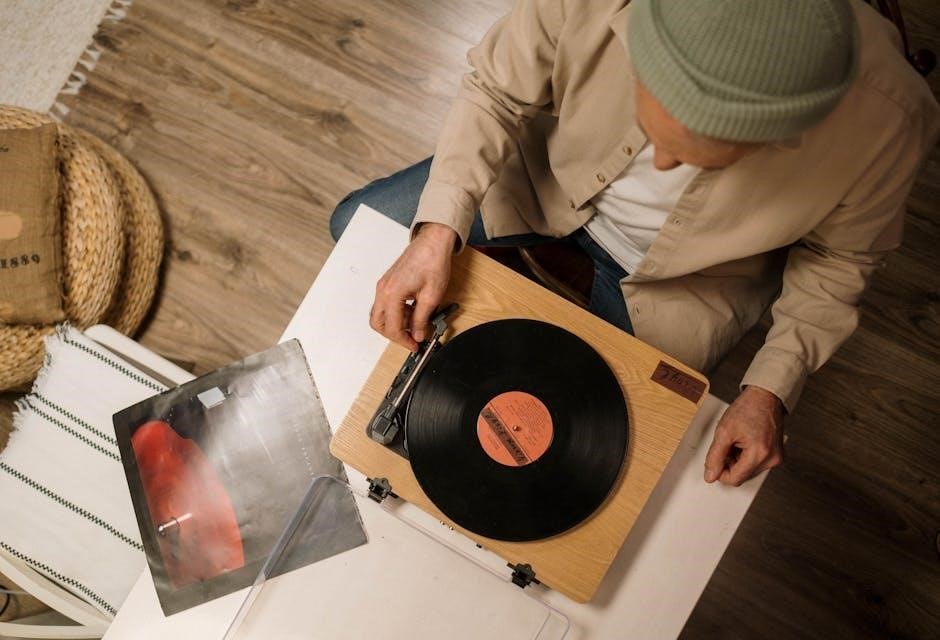
Begin by placing a vinyl record onto the turntable platter. Ensure the platter is clean and free of debris. Power on your Crosley record player. Select the appropriate speed setting – 33 ⅓ RPM for LPs and 45 RPM for singles. Release the tonearm lock, allowing it to move freely across the record.
Gently lift the tonearm using the cueing lever and position the stylus just above the record’s edge. Slowly lower the tonearm using the cueing lever, allowing the stylus to settle into the groove. Adjust the volume to a comfortable level.
Monitor the playback for any distortion or skipping. If issues arise, check the tracking force and balance. At the record’s end, the tonearm will automatically return to its resting position. Remember to re-engage the tonearm lock when not in use.
Adjusting the Volume and Sound Settings
Crosley record players typically feature a volume knob located on the unit’s front or side panel. Rotate this knob clockwise to increase the volume and counter-clockwise to decrease it. Start with a low volume and gradually increase it to your desired listening level, protecting both your ears and the speakers.
Many models offer additional sound settings, including bass and treble controls. These adjustments allow you to customize the audio output to suit your preferences and the characteristics of the record. Experiment with these settings to find the optimal sound balance.
If your player has RCA outputs, connecting to external speakers or a stereo system provides greater control over sound quality. Utilize the external system’s volume and equalization settings for a more refined listening experience. Remember to always prioritize safe listening volumes.
Bluetooth Connectivity and Usage
Many Crosley record players incorporate Bluetooth technology, enabling wireless connection to smartphones, tablets, and other Bluetooth-enabled devices. To initiate pairing, first ensure your record player is in Bluetooth mode – typically activated by a dedicated button or switch. The player will then become discoverable.
On your device, navigate to the Bluetooth settings and scan for available devices. Select your Crosley record player from the list. You may be prompted to enter a pairing code (often “0000”). Once connected, you can stream audio wirelessly to the record player’s built-in speakers.
Bluetooth functionality also allows some models to act as Bluetooth transmitters, sending audio from vinyl records to Bluetooth headphones or speakers. Refer to your specific model’s instructions for details on switching between transmitter and receiver modes. Enjoy the convenience of wireless audio!
Auxiliary Input/Output Functions
Crosley record players often feature auxiliary (AUX) input and output ports, expanding their versatility. The AUX input allows you to connect external audio sources, such as smartphones or MP3 players, to play music through the record player’s speakers. Simply use a standard 3.5mm audio cable to connect your device to the AUX input jack.
The AUX output enables you to connect your record player to external speakers or an amplifier for enhanced sound quality. This is particularly useful if you desire a more powerful or refined audio experience than the built-in speakers provide. Again, a 3.5mm audio cable is typically used for this connection.
Some models may also include RCA outputs in addition to, or instead of, the 3.5mm AUX output. Always ensure the volume on both the record player and the connected device is at a reasonable level to prevent distortion or damage. Experiment with these connections to tailor your listening setup!
Troubleshooting Common Issues
Experiencing problems? Here’s a guide to resolving common issues with your Crosley record player. If there’s no sound, check the power connection, volume level, and ensure a record is properly placed on the turntable. Verify the stylus is correctly installed and not damaged.
Distorted sound can often be traced to a dirty stylus or a worn-out record. Clean the stylus gently with a stylus brush and inspect your records for scratches. If the turntable isn’t spinning, confirm the belt is correctly installed and in good condition – replacement may be necessary.
Bluetooth connectivity issues? Ensure Bluetooth is enabled on both your record player and your device. Try forgetting and re-pairing the devices. Persistent problems may require a factory reset (consult your model’s specific instructions). For further assistance, refer to the support resources listed at the end of this manual.
Replacing the Belt (If Applicable)

Is your turntable slowing down or not spinning consistently? The drive belt may need replacing. First, disconnect the power supply. Gently remove the platter, typically by lifting upwards after releasing any retaining clips. Locate the old belt around the motor pulley and turntable spindle.
Carefully remove the worn belt, avoiding any strain on the pulley or spindle. Clean both components with a soft, dry cloth. Install the new belt, ensuring it’s seated correctly around both the motor pulley and the turntable spindle. Double-check for proper alignment and tension.
Replace the platter, securing it with the retaining clips if applicable. Reconnect the power supply and test the turntable’s operation. A properly installed belt will ensure smooth and consistent record playback. Refer to your model’s specific diagram for detailed instructions if needed.
Cleaning and Maintenance
Regular cleaning extends your Crosley record player’s lifespan and maintains optimal sound quality. Always disconnect the power supply before cleaning. Dust the exterior with a soft, dry cloth. Avoid using harsh chemicals or abrasive cleaners, as they can damage the finish.
Clean the platter and tonearm with a slightly damp cloth, ensuring it’s thoroughly dry afterward. Periodically clean the stylus with a stylus brush, gently removing dust and debris. Brush in a back-to-front motion only, never side-to-side or circular.
Inspect the belt (if applicable) for wear and tear, replacing it if necessary. Store your records in their sleeves to prevent dust accumulation. Keep the turntable covered when not in use to protect it from dust and sunlight. Proper maintenance ensures years of reliable performance.
Crosley Record Player Features Comparison (Voyager vs. Cruiser Plus)
Both the Crosley Voyager and Cruiser Plus offer portable vinyl experiences, but key differences exist. The Voyager typically features a more robust build quality and often includes improved sound output due to larger speakers. It frequently boasts enhanced Bluetooth connectivity for seamless streaming.
The Cruiser Plus, generally more affordable, prioritizes compact design and vibrant color options. While still offering Bluetooth, its speaker quality may be slightly less powerful than the Voyager. Both models support multiple playback speeds (33 ⅓, 45, and 78 RPM) and include auxiliary input/output.
Consider the Voyager if portability and superior sound are paramount. The Cruiser Plus is ideal for casual listeners seeking a stylish, budget-friendly option. Ultimately, the best choice depends on individual needs and preferences regarding sound quality, portability, and price point.
Understanding Crosley’s Built-in Speakers
Crosley record players integrate built-in speakers for convenient, all-in-one listening. However, these speakers are generally designed for portability and casual use, rather than audiophile-grade sound reproduction. Speaker size and wattage vary between models – the Voyager often features larger speakers than the Cruiser Plus, resulting in fuller sound.
Expect a noticeable improvement in audio quality by connecting your Crosley player to external speakers via the auxiliary output. This bypasses the internal speakers, leveraging the capabilities of a dedicated sound system. Volume control adjusts the output of both the built-in speakers and the auxiliary output.
Consider the built-in speakers as a convenient starting point. For a richer, more immersive listening experience, especially with larger rooms, external speakers are highly recommended. Proper placement of the record player can also optimize sound projection from the internal speakers.
Advanced Settings and Customization
Beyond basic operation, Crosley record players offer limited advanced settings, primarily focused on Bluetooth connectivity and sound adjustments. Bluetooth pairing allows wireless streaming from smartphones and tablets; consult your model’s specific instructions for pairing procedures. Sound customization is typically restricted to volume control and, on some models, basic equalization presets.
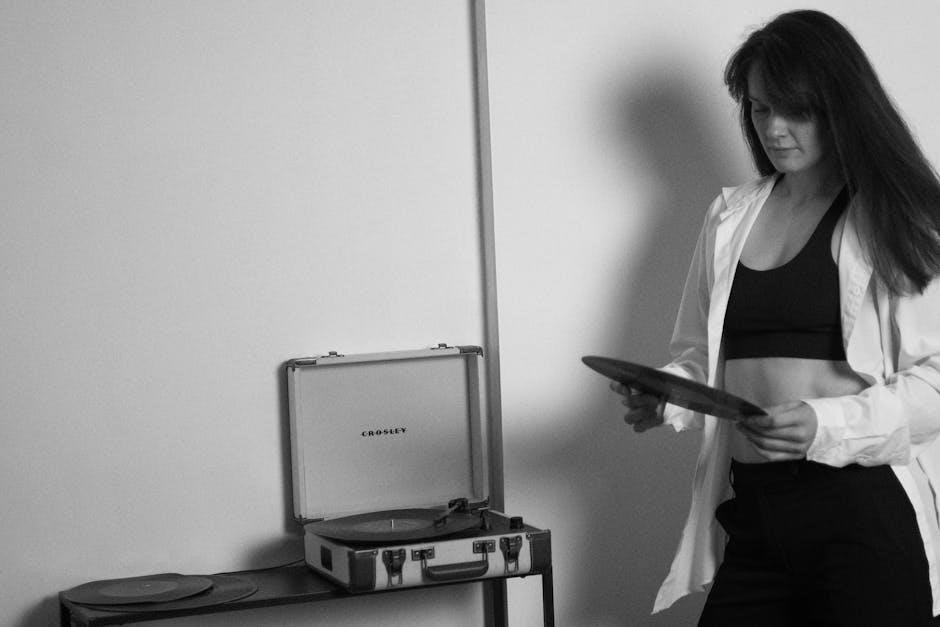
For users seeking greater control, connecting via the auxiliary output to an external amplifier or receiver unlocks a wider range of audio customization options. Tracking force and anti-skate adjustments, while present on some models, require careful calibration to avoid damaging records or stylus wear.
Customization options are generally limited compared to high-end turntables. Focus is on ease of use and portability. Experiment with speaker placement and external audio equipment to optimize your listening experience. Refer to online forums and communities for user-shared tips and tricks.
Safety Precautions and Warnings
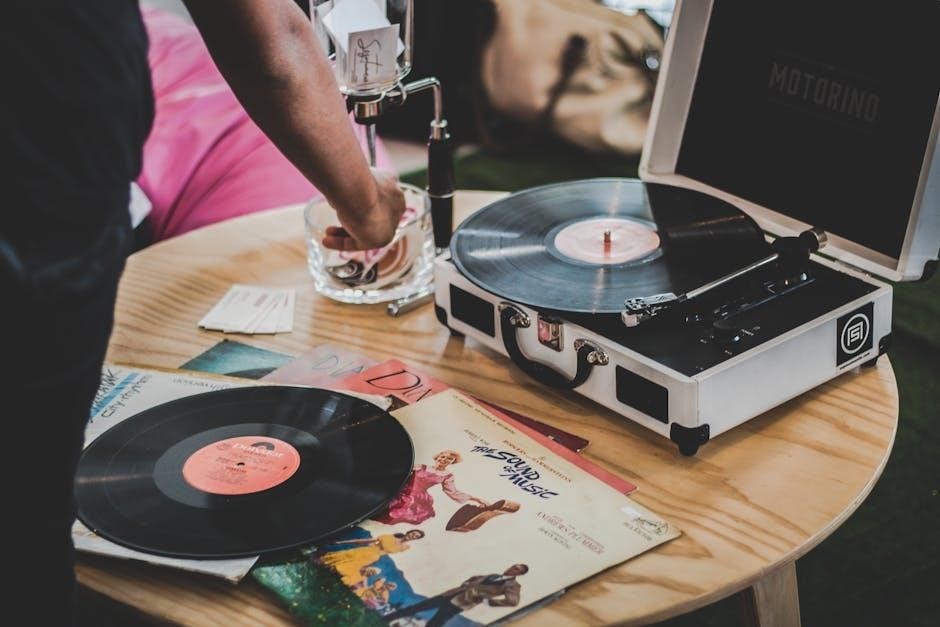
To ensure safe operation and prevent damage to your Crosley record player and your records, adhere to these precautions. Always disconnect the power supply before cleaning or performing maintenance. Never expose the unit to excessive moisture or extreme temperatures. Avoid placing heavy objects on the turntable lid, as this could cause damage.
Handle records with care, avoiding fingerprints and scratches. Do not attempt to disassemble or repair the unit yourself; refer servicing to qualified personnel. Keep the stylus clean to maintain optimal sound quality and prevent record wear. Be mindful of the power cord to prevent tripping hazards.
Warning: Prolonged exposure to loud volumes may cause hearing damage. Use caution when adjusting the volume. Keep out of reach of small children. Never insert objects into the unit’s vents. Follow all instructions and warnings to enjoy your Crosley record player safely.
Where to Find Additional Support and Resources
For comprehensive assistance beyond this manual, Crosley offers a wealth of online resources. Visit the official Crosley Audio website for FAQs, troubleshooting guides, and downloadable manuals for various models, including Voyager and Cruiser Plus. Explore their support section for detailed articles addressing common issues.
Connect with the Crosley community through their social media channels – Facebook, Twitter, and Instagram – for tips, tricks, and user-to-user support. YouTube hosts numerous tutorial videos demonstrating setup, maintenance, and advanced features. Recordbuilds.com provides independent reviews and comparisons.
If you require direct assistance, contact Crosley’s customer support team via email or phone; details are available on their website. Consider online forums dedicated to vinyl and record players for expert advice. Remember to have your model number handy when seeking support for faster resolution.